
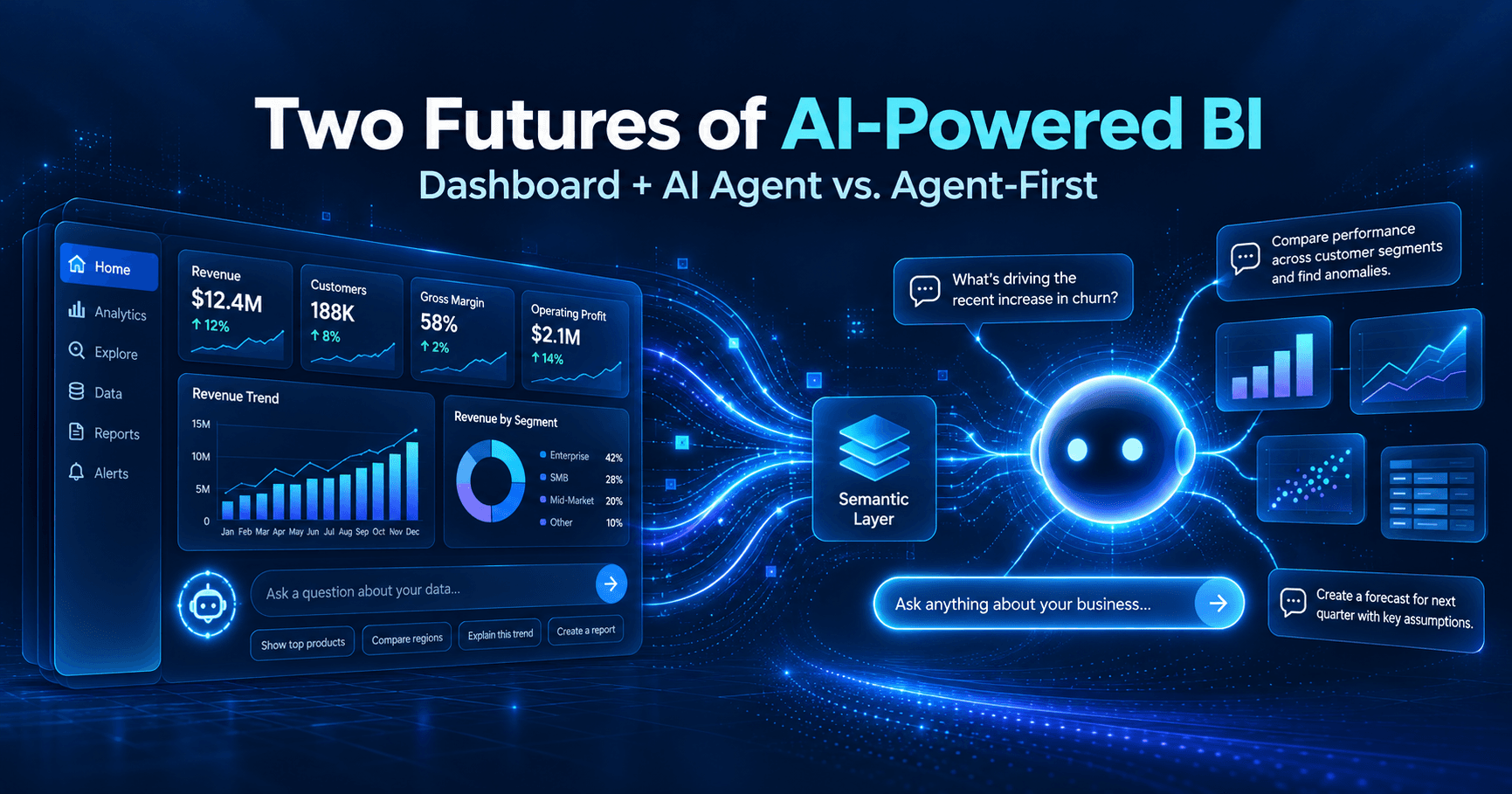
Two Futures of AI-Powered BI: Dashboard + AI Agent vs. Agent-First
By @Jin5 min read
In my previous article, I explained how AI Agents could change Business Intelligence (BI) architecture. Instead of opening dashboards, business users could directly ask AI agents to analyze data.
After reviewing the BI projects that I made in the real world, I started to see two possible approaches for the future of BI :
Dashboard + AI Agent, and Agent-First BI.
I think the choice between them depends on the scope of the data, the number of users, and how predictable their questions are.
1. Dashboard + AI Agent: When the Business Scope Is Clearly Defined
Let me start with a project I worked on. I developed a procurement analytics solution called SpendCube using Azure Databricks, Azure SQL Database, and Power BI.
The project had a clearly defined business scope. It was designed only for the procurement team, and all the KPIs were related to procurement activities.
Some of these KPIs had complex business rules. I needed to discuss requirements with business owners, agree on calculation methods, and validate the results.
However, the purpose of the system was clear: help the procurement team monitor and analyze its purchasing activities.
For this kind of project, I believe a dashboard combined with an AI agent would be a very practical solution.
The dashboard provides a clear overview of important KPIs. Users can quickly check purchasing performance, compare different periods, and identify changes.
At the same time, an AI agent could provide more flexibility. AI agent could investigate the data, identify possible reasons, and create additional visualizations.
For companies that already have Power BI dashboards, the next step could simply be adding an AI agent instead of rebuilding the entire BI system.
Power BI Copilot is a good example of this approach. Organizations with the required Premium or Fabric capacity can use Copilot to let users explore their data through natural language.
The key challenge is making sure the AI agent and the dashboard return the same results. If a user asks the AI agent for a KPI that already exists in the dashboard, both should provide the same value. To achieve this, the AI agent should use the existing semantic model, including its approved DAX measures and business rules, rather than creating its own calculations.
2. Agent-First BI: When Data Is Too Complex for Predefined Dashboards
Now let's consider a very different situation.
In my previous article, I discussed BMW's Mobile Data Recorder project.
According to Microsoft's case study, BMW operates around 3,500 development vehicles, and its system collects more than 10,000 signals per vehicle.
Imagine being an engineer working with this enormous dataset.
One engineer wants to analyze braking behavior under certain conditions. Another wants to investigate battery performance. A third wants to understand unusual sensor readings.
Different engineers work on different problems, and their questions can change every day.
Unlike my SpendCube project, this isn't a situation where a small group of users mainly monitors a fixed set of KPIs.
It would be extremely difficult to predict all possible questions and build dashboards for them in advance.
Even if hundreds of dashboards existed, engineers might still need new queries and visualizations to answer their specific questions.
For this kind of environment, I believe an agent-first approach would make more sense.
Instead of opening a dashboard and looking for the right chart, engineers could directly describe what they want to investigate.
The AI agent could identify relevant data, generate queries, analyze the results, and create visualizations when needed.
In fact, BMW has already introduced elements of this approach. Its MDR copilot uses natural language to generate KQL queries and can also use knowledge collected from expert interviews.
Instead of building dashboards for questions we can predict, we could build AI agents that help users answer questions we cannot predict.
3. How Do We Choose the Right Approach?
The choice is not mainly about company size or data volume, but how clearly the business scope is defined and how predictable users' questions are.
For well-defined business requirements, a dashboard combined with an AI agent is often a practical solution.
For complex, open-ended data exploration, an agent-first approach may offer more flexibility.
Both approaches can also exist within the same company.
4. Final Thoughts
I believe AI agents will become an important part of Business Intelligence, but not every BI system needs to become agent-first.
The future of BI is not about replacing dashboards, but choosing the right interface for different analytical needs.
For data professionals, this also means a shift in focus: from building individual dashboards to creating trusted, reusable data foundations that support both dashboards and AI agents.
---
_Thanks for reading_ _Data in the Age of AI__. Follow along for more thoughts on data, AI, and Business Intelligence, or connect with me on_ _LinkedIn__._
Related Articles
The newsletter
Data in the Age of AI
Exploring how AI is reshaping business intelligence, data architecture, and the way organizations work with data. Get new essays from @Jin delivered to your inbox.
Visit the publication on Substack →Add Comments
Comments
Loading comments...