
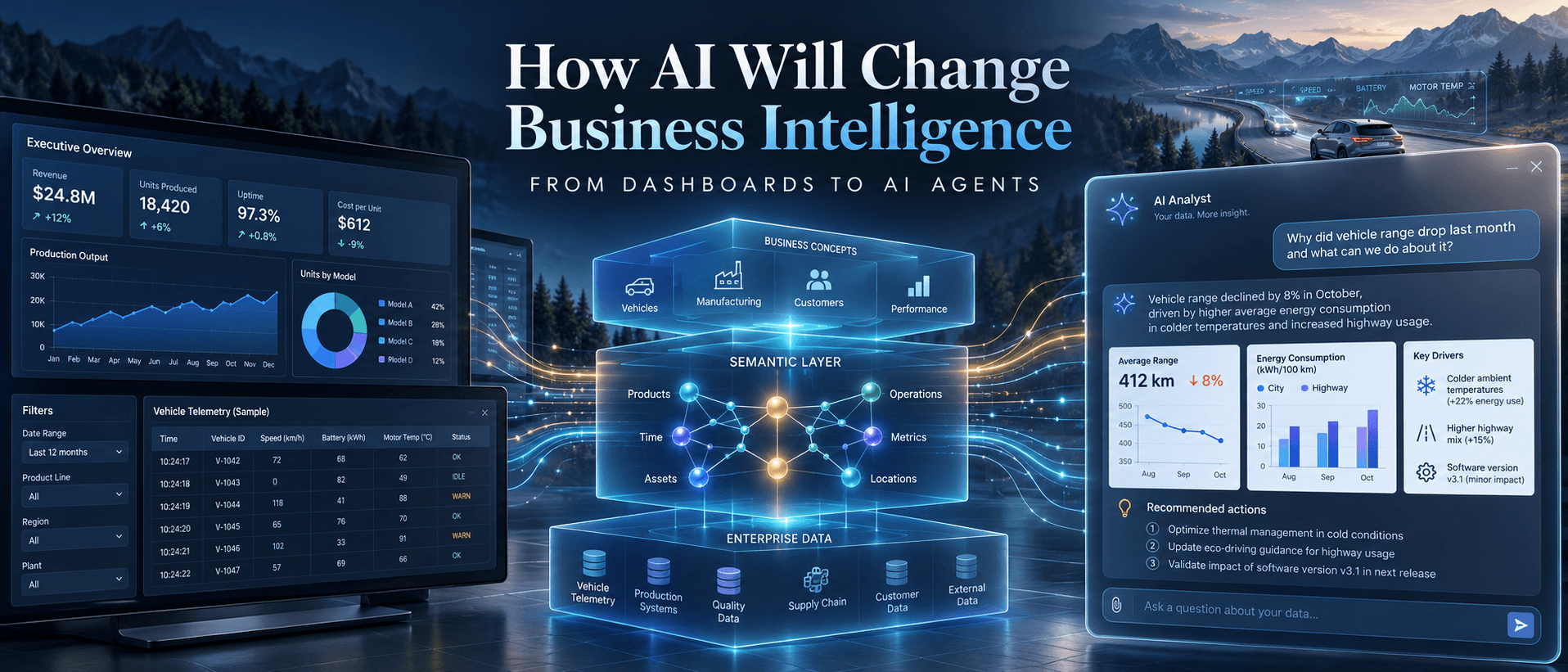
How AI Will Change BI - From Dashboards to AI Agents
By @Jin5 min read
For years, Business Intelligence (BI) has followed a familiar workflow: data engineers build models, data analysts create dashboards, and then deliver them to business users.
AI is changing this workflow. Instead of opening a fancy Power BI or Tableau dashboard, users could ask AI questions directly, just like chatting with ChatGPT.
Thanks for reading Data in the Age of AI! Subscribe for free to receive new posts and support my work.
If AI will become the primary gateway to data analysis, what does it mean to data developer?
A real Example from BMW: Making Complex Data Accessible to Everyone
I recently watched an interview with Microsoft’s CoreAI leadership that discussed an interesting example from BMW.
BMW operates thousands of development vehicles that generate enormous amounts of testing data. According to Microsoft’s BMW case study, its Mobile Data Recorder system captures more than 10,000 signals per vehicle, covering measurements such as braking, engine performance, and battery behavior.
In a traditional BI workflow, data engineers build pipelines and prepare datasets, then data analysts define KPIs, create dashboards, and deliver reports to end users.
But imagine what happens when data becomes extremely large and complex, with hundreds of business requirements constantly changing.
Making AI Understand the Data, Not Human
What impressed me most about BMW’s approach was not the AI technology itself, but the preparation behind it.
In the interview, the speaker described that BMW spent six months working with different teams to build a data dictionary and document what their data actually meant.
Imagine I were one of the people working on BMW’s project. I’m sitting in a meeting where a business team is explaining some incredibly complex business rules. Throughout the meeting, I have ChatGPT’s live voice mode running on my phone, listening to the discussion.
At some point, someone from the business team turns to me and asks, “Do you understand everything?”
I might simply turn to my phone and ask, “ChatGPT, did you get all that?”
It sounds funny, but it reflects a fundamental shift in how we work with data. The goal is no longer for one engineer to understand and remember every business rule. It’s to make that knowledge understandable to AI. Of course, the AI’s understanding still needs to be verified by business experts.
BMW’s engineers can now ask questions in natural language, such as how many braking maneuvers were performed over the last two days, and receive results with charts and explanations. According to Microsoft’s follow-up case study, its multi-agent system has demonstrated the potential to accelerate analysis by up to 12 times.
From Dashboards to Semantic Models and AI Agents
For me, BMW’s example illustrates a much broader shift in Business Intelligence.
Instead of expecting AI to figure out business meaning directly from raw tables, we need a trusted layer that defines metrics, relationships, and business rules. AI agents can then use that context to answer questions consistently.
This is why I believe semantic models connected to AI agents will become a new way of delivering BI.
Instead of delivering individual dashboards for predefined questions, data teams can deliver a reusable, governed foundation that allows business users to explore data and generate insights on demand.
BMW is already demonstrating what this kind of transformation can look like in practice.
Why the Semantic Layer Matters More Than Ever
If AI agents become the primary interface for data analysis, one of the biggest challenges will be translating Text into SQL and ensuring that the results are actually correct.
When I talk about the semantic layer, I don’t just mean the Gold Layer tables that feed dashboards in a traditional data architecture. I mean a broader system of business context, including semantic models, KPI definitions, data relationships, calculation rules, and the logic behind how data should be interpreted.
For example, calculating a sales win rate seems simple: won opportunities divided by total opportunities. But what counts as a won opportunity? Should open or cancelled opportunities be included? Which date should determine the reporting period? AI can generate syntactically correct SQL while still producing a completely wrong business result.
Traditionally, semantic models were often designed around predefined KPIs and reporting requirements, with much of the business logic understood and maintained by data engineers and analysts.
But when AI agents replace dashboards as the main entry point for exploring data, the way we design the semantic layer needs to change. Instead of supporting only predefined reports, it must provide enough business context for AI to answer questions that were never anticipated during development.
The semantic layer is no longer just the foundation of consistent reporting. It becomes the foundation of reliable AI-driven analytics. Its quality directly determines how accurately AI agents interpret business questions, and those answers ultimately influence real business decisions.
My Takeaway
The future of BI is not simply AI replacing dashboards. It is a shift from dashboard-centered analytics to AI-assisted, context-driven analytics.
The BMW case presents a real-world project that illustrates how AI can unlock the potential of messy data.
For data teams, I believe the biggest change will be in what we deliver. Instead of building individual dashboards to answer specific business questions, we will increasingly build governed semantic models connected to AI agents, enabling users to explore data, ask questions, and generate insights on demand.
Related Articles
The newsletter
Data in the Age of AI
Exploring how AI is reshaping business intelligence, data architecture, and the way organizations work with data. Get new essays from @Jin delivered to your inbox.
Visit the publication on Substack →Add Comments
Comments
Loading comments...